You've been there: you download a wallpaper that looks gorgeous in the preview, set it as your background, and it comes out soft, cropped weirdly, or zoomed in so far that the subject's face is cut in half. The image wasn't bad. The size was wrong for your phone.
The fix isn't complicated, but it isn't one number either. Phones have different screen shapes, and launchers crop differently. So instead of memorising a dimension, it helps to understand the two ideas that actually decide whether a wallpaper looks good: start with more pixels than you need, and keep the important stuff away from the edges.
The short version
For most modern phones, start with a high-quality portrait image that is at least 1080 pixels wide. A 1080 × 2400 image works well for many Android phones, while iPhone models vary by screen. The safest method is to choose a tall image and preview the crop before applying it.
That "at least 1080 wide" is a floor, not a target. More pixels give the phone room to crop without stretching. An image that's exactly your screen size has zero slack — the moment your launcher zooms it even slightly, it softens. An image that's bigger than your screen can absorb that zoom and still look sharp.
Why one size does not fit every phone
Phone screens use different aspect ratios. Some devices are close to 19.5:9 while others are taller — and a few are notably wider or narrower. Launchers may also zoom or shift a wallpaper when you swipe between home-screen pages, which is the parallax effect: the background slides slightly as you move, which means the phone needs extra image beyond the screen edges to slide into.
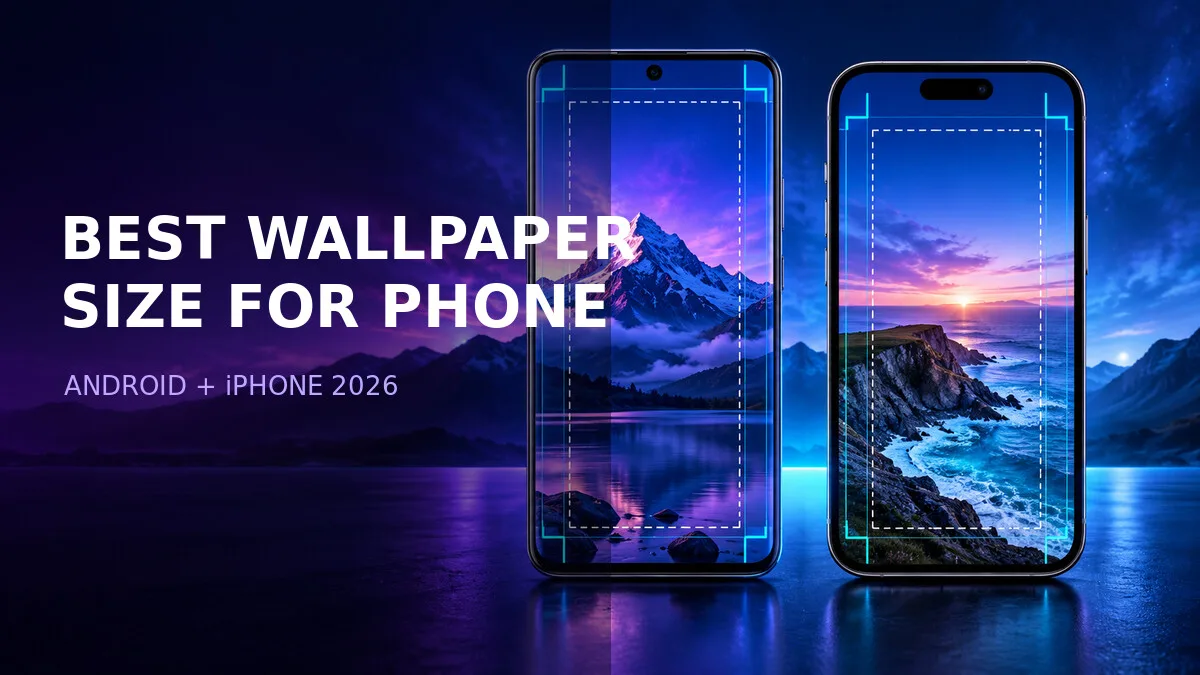
This is why important faces, text, or details should not sit against the edges. Whatever is near the border may be cropped, shifted, or covered depending on the phone, the launcher, and whether parallax is on. Treat the outer 10% or so of the image as a danger zone, and keep your subject in the centre-safe area.
It also explains why a wallpaper that looked perfect on your old phone looks wrong on your new one. Different screen, different crop, different result — same file. The image didn't change. The frame did.
Recommended wallpaper dimensions
Use these as starting points, not gospel. If your phone is newer or has a higher-resolution screen, go bigger — bigger never hurts.
- **Android phones:** 1080 × 2400 or larger
- **Compact phones:** 1080 × 1920 or larger
- **High-resolution phones:** 1440 × 3200 when available
- **Square source images:** crop them to portrait before use
That last one deserves emphasis. A square image on a tall phone screen has to be stretched or aggressively cropped to fill the display, and both options look bad. If your source is square — an Instagram-style image, say — crop it to portrait yourself, choosing what gets cut, rather than letting the phone decide. The phone's automatic crop is rarely kind to faces.
For iPhones specifically, the exact ideal dimensions vary by model because screen sizes differ across the lineup. Rather than chasing a per-model table that goes stale every September, use the same rule: tall, at least 1080 wide, and preview the crop on your actual device. The preview is the truth; a spec table is a guess.
Keep the clock area readable
Leave a calm area near the upper third of a lock-screen wallpaper. Busy highlights behind the clock can make notifications hard to read. Dark gradients, sky, and soft blur usually work well — they give white clock text something quiet to sit on.
This is the part people forget when they fall in love with a dramatic image. A lightning storm or a neon cityscape looks incredible in the gallery, and then at 6 a.m. you can't read the time because the clock is sitting on a white lightning bolt. If you love a busy image, try it as a home-screen wallpaper instead, where there's no clock competing with it — or pick a version of the image with a calmer top third.
How to apply without losing quality
- Download the original HD image instead of taking a screenshot.
- Open Settings and choose Wallpaper or Wallpaper & style.
- Select the downloaded file and preview the crop.
- Keep the main subject inside the centre safe area.
- Check both the home screen and lock screen before saving.
Step 1 is where most quality is lost, and it's invisible until it's too late. A screenshot captures the image at screen resolution, re-compressed, with whatever the screen was showing — browser bars, status icons, the lot. The original file is bigger, cleaner, and free of all that. Always download the original.
Step 5 matters because the two screens crop differently. A lock-screen preview and a home-screen preview can show surprisingly different crops of the same image. Check both before you hit save, or you'll fix the lock screen and break the home screen.
The one rule to remember
Start with more pixels than your screen needs. Cropping a large image normally stays sharp, but stretching a small image creates blur and visible blocks. If you only remember one sentence from this guide, make it that one.
And if your picture still looks too close after all this — like you're seeing a zoomed-in slice of the image rather than the whole thing — that's a different problem with a different fix. Use the wallpaper zoom and crop troubleshooting guide to distinguish a framing issue from a low-resolution source.